Federated AI for financial institutions
Use-Case

Federated AI in Finance

Enhancing security, compliance, privacy, and predictive accuracy in financial services through collaborative machine learning.
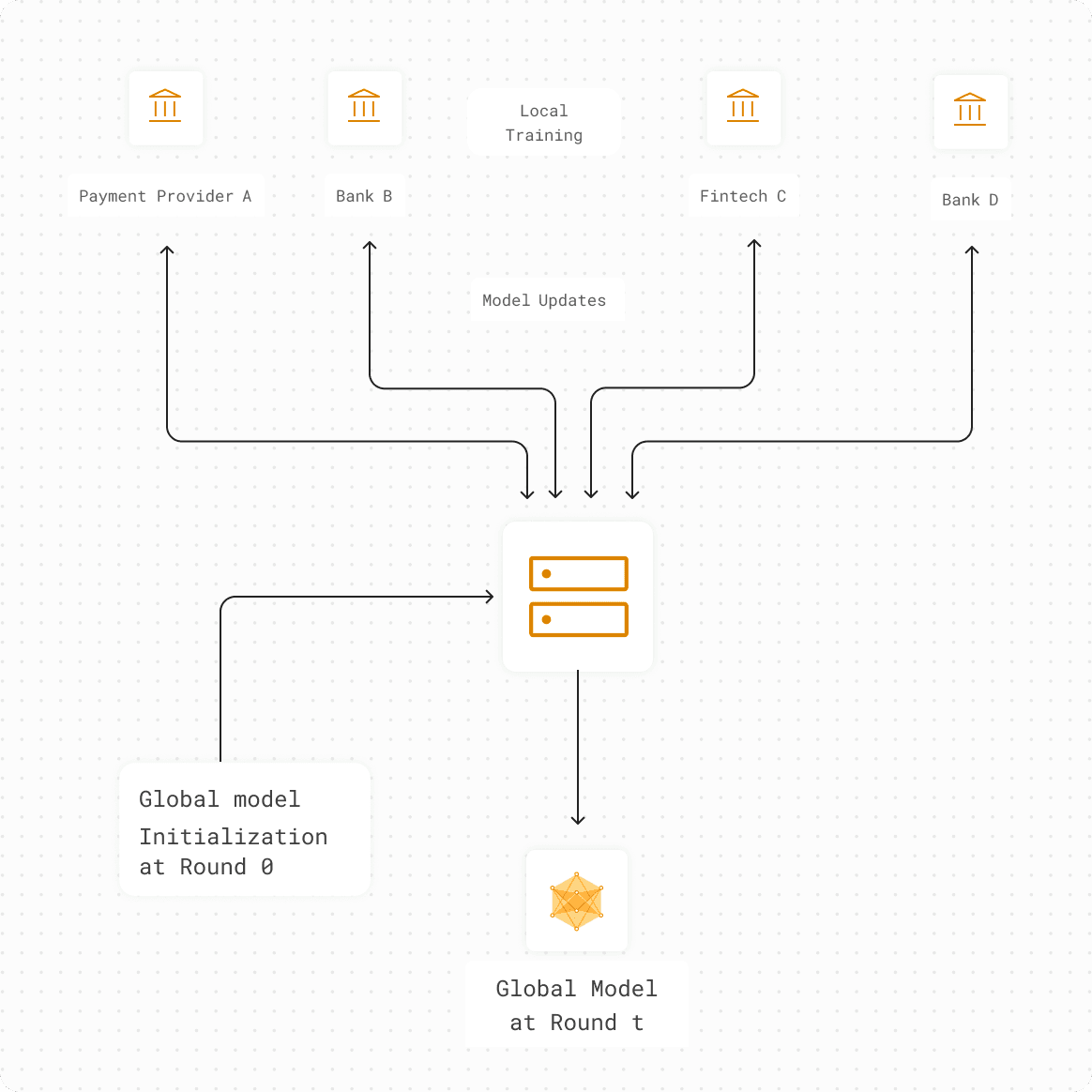
Federated learning architecture for finance

Federated Learning is revolutionizing finance

Federated Learning allows financial institutions to collaboratively train machine learning models on decentralized data while supporting privacy and compliance requirements. Banks, insurers, and investment firms can use broader datasets without sharing the underlying data. By aggregating insights from diverse sources, Federated Learning improves model accuracy for risk assessment, fraud detection, and personalized services while respecting finance-specific regulations.
Challenges

Challenges faced in finance

Financial institutions need stronger models, but regulatory constraints, fragmented data, and competitive boundaries make centralized training difficult.

Data Privacy and Security

Financial institutions handle highly sensitive data that must comply with strict privacy regulations. Federated Learning keeps data localized, reducing the risk of data breaches while supporting GDPR, CCPA, and other regulatory requirements.

Fraud Detection

Detecting fraudulent activity requires analyzing patterns across multiple data sources. Federated Learning lets institutions train on broader signals from multiple entities, improving fraud detection without moving sensitive customer data.

Risk Management

Accurate risk assessment models are crucial for financial stability. With Federated Learning, institutions can build more robust models from diverse datasets, improving predictions for market trends, credit risks, and investment opportunities.

Regulatory Compliance

Financial institutions must comply with regulations like AML, KYC, and Basel III. Federated Learning enables decentralized analysis for transaction monitoring and risk assessment while keeping sensitive data within regulatory boundaries.

Financial institutions collaborating across borders
Federated Learning Pattern

Cross-border data

Financial institutions often operate across multiple jurisdictions, each with strict data privacy regulations such as GDPR in Europe or CCPA in the United States. These rules limit the ability to transfer sensitive customer data across borders for centralized analysis.

How Federated Learning solves this challenge: Institutions train machine learning models locally inside each country or region and share only model updates with a central server. Those updates are aggregated to improve a global model without exposing raw data, supporting regional compliance while still benefiting from broader global signals.

Financial organizations collaborating through Federated Learning
Federated Learning Pattern

Cross-organizational collaboration

Banks, insurance companies, and investment firms often operate in silos, holding proprietary or sensitive data they cannot share with competitors. This makes collaboration on fraud detection, risk management, and personalization difficult.

How Federated Learning solves this challenge: Each organization trains models on its own data and shares only model parameters or updates. The central aggregation process improves the global model while protecting private data and preserving competitive boundaries.

Production Example

Enhancing Banking Circle's Anti-Money Laundering System with Flower

Banking Circle, a fully licensed next-generation payments bank, addresses the global banking needs of payments businesses, banks, and marketplaces. Through its API, the company offers fast, low-cost global payments and banking services by connecting to the world's clearing systems, enabling real-time liquidity movement for all major currencies securely and compliantly. Serving over 250 regulated businesses, Banking Circle processes more than 10% of Europe's B2C e-commerce flows and processed payments worth 558 billion euros in 2023. To address the time-consuming and costly nature of Anti-Money Laundering (AML), the company developed a transaction monitoring system that scans payments for suspicious behavior and pre-selects cases for manual analysis.

Banking Circle logo
Robert Norvill

"Flower was exactly the solution we were looking for."

Robert Norvill, Senior Data Scientist @ Banking Circle

Europe B2C e-commerce flows processed

10%+

Payments processed in 2023

€558B

Precision increase in initial testing

+65%

Recall increase in initial testing

+25%

Banking Circle is revolutionizing cross-border transactions

Banking Circle is building a super-correspondent banking network, aiming to cut transaction times from five days to five seconds and costs from 50 euros to 50 cents. Tackling the intensive and costly process of Anti-Money Laundering (AML), they've developed an AI-powered transaction monitoring system that screens transactions for suspicious activity, reducing manual analysis time. This system, however, faces challenges in the US market due to differences in transaction types and data transfer difficulties.

To overcome these challenges

Banking Circle employs Flower, a federated learning system, to train the AI model on European data without moving it across borders. This allows them to develop a model tailored to the US market, improving accuracy and efficiency over time. As the US model evolves, it feeds improvements back into the European system, benefiting both regions. Initial testing of this federated learning approach showed significant performance improvements, including a 65% increase in precision, a 25% increase in recall, and a 10% increase in accuracy, highlighting how federated learning can drive innovation in the finance industry by enabling transformative solutions.

FLAME

Federated Learning for Anti-Money laundering Enhancement

The FLAME architecture shows how Banking Circle applied federated learning to anti-money laundering workflows while preserving data locality across jurisdictions.
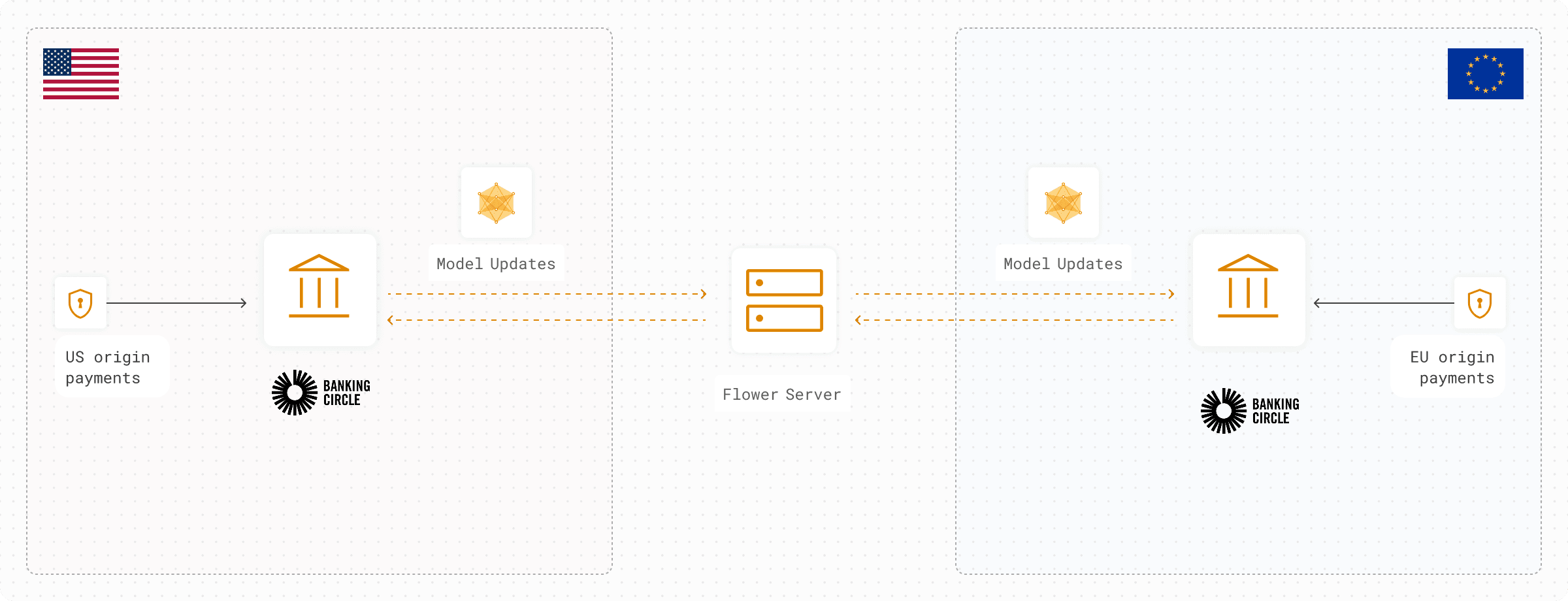
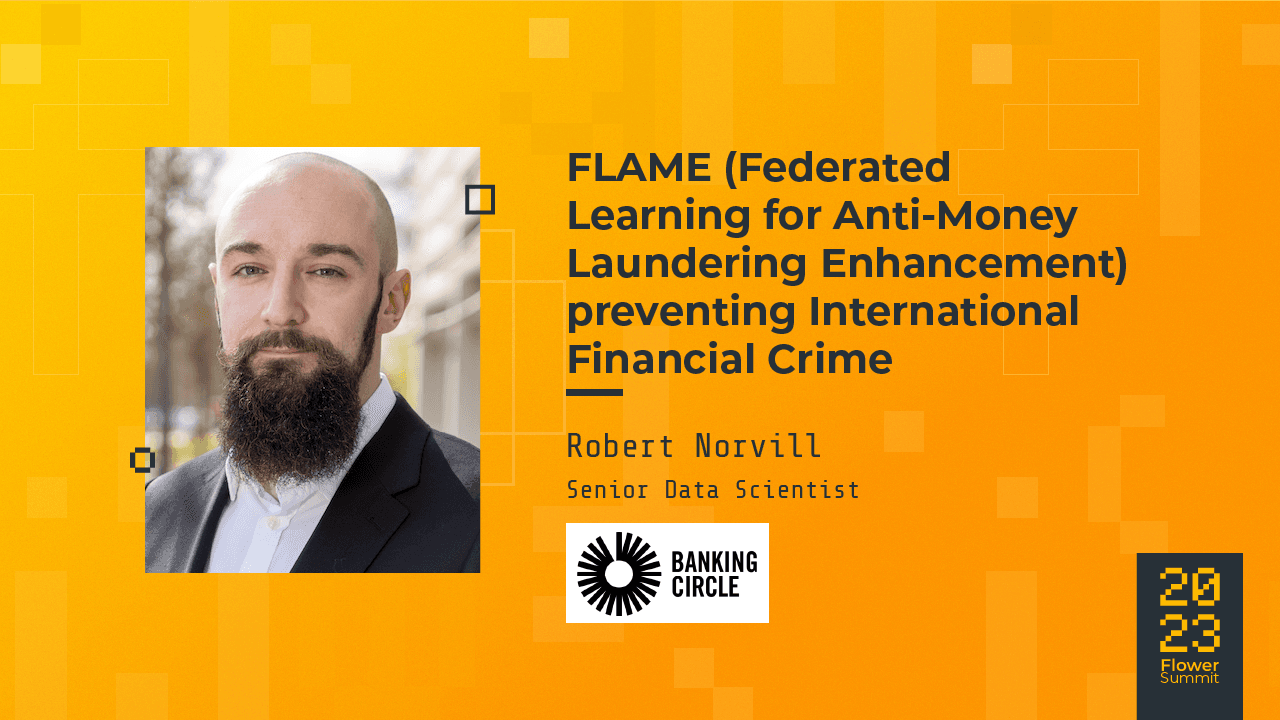
FLAME architecture for anti-money laundering enhancement

Explore finance applications and research from the Flower community
Federated and Privacy-Preserving Learning of Accounting Data in Financial Statement Audits
Privacy Preserving Neural Network Predictive Modelling in Insurance using Horizontal Federated Learning
A Privacy-Preserving Hybrid Federated Learning Framework for Financial Crime Detection
The Effects of Data Imbalance Under a Federated Learning Approach for Credit Risk Forecasting

Experience the future of finance with Federated Learning

Request a demo to explore how Federated Learning enhances security, privacy, and predictive accuracy in financial services.