@zenos/rare-disease-consult-network
flwr new @zenos/rare-disease-consult-networkRare Disease Consult Network
A Flower federation where a clinician consults every hospital at once about a patient nobody can place — and an adversarial panel attacks the answers before they reach anyone.
Track 1 — SuperGrid. Collaborative Agent Hackathon, Cambridge, 26 August 2026.
The idea
A rare disease is rare at any one hospital and not rare across fifty. The consultant seeing an unusual presentation has one or two comparable cases in living memory and no way to reach the three sitting in a hospital two hundred miles away. The data that would settle the question exists; it is just distributed, and it cannot be centralised, because it is patient records.
So the query travels instead of the data.
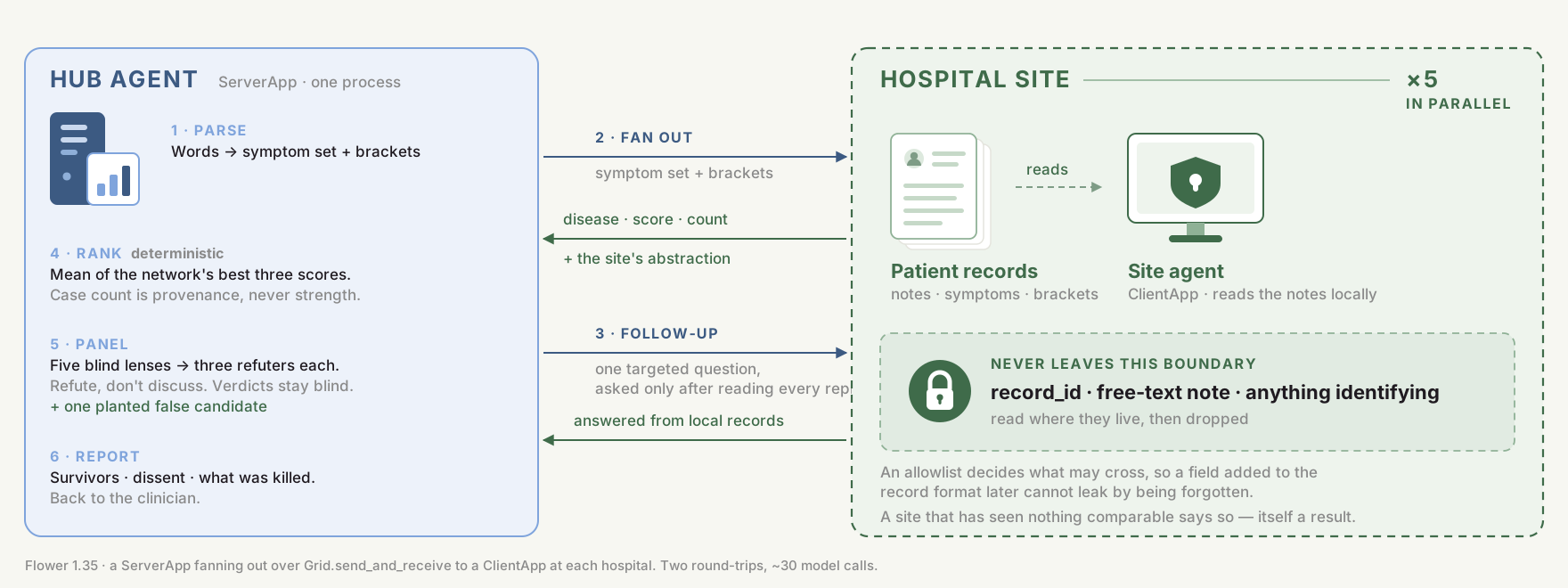
Six stages: the clinician's description is parsed into a structured query; it fans out to every hospital at once; each site searches its own records and its own agent reads the matching notes locally; the hub asks one targeted follow-up it could not have known to ask at the start; the panel attacks what came back; the master reports what survived.
The site agent is the privacy boundary
The obvious way to protect the free-text notes is to refuse to send them. That also throws away the clinical richness — the temporal course, the response to treatment, the finding that was notably absent — which is most of what distinguishes a rare disease from a common one.
Putting a reading agent inside the hospital keeps both. The note never moves, and its content still reaches the network as an abstraction the site wrote: "all four of our cases showed slit-lamp-confirmed Kayser–Fleischer rings; none had fever at onset." What crosses the wire is a judgement, not a record.
_strip_for_wire is an allowlist rather than a blocklist, so a field added to the record format later cannot leak by being forgotten.
Case count is provenance, not strength
The corpus is wildly uneven — 3,528 cases of community-acquired pneumonia, 8 of addisonian crisis. Any score that scales with the number of matching patients hands the top of the list to whatever is best published, which is the exact opposite of the point.
So ranking uses the mean of the network's best three similarity scores, taking fewer if fewer exist and never padding with zeros. One case at 0.80 beats a hundred cases topping out at 0.80 / 0.79 / 0.78. Case count travels as provenance and never touches the score; it is labelled as such in every prompt, so a lens cannot quietly read volume as evidence.
Similarity itself is deliberately dumb — Jaccard overlap of symptom sets, computed by identical code at every site. It has to be: sites are separate processes in separate institutions, and if each scored with its own model call, a 0.85 from one and a 0.85 from another would not be the same claim. Retrieval decides what gets discussed. The agents decide what it means.
The panel never converges by discussion
Five lens agents assess the network's candidates independently and in parallel, each with a disjoint mandate — symptom fit, demographic plausibility, common explanations, evidence quality, contradicting evidence. None can see the others.
Then every candidate is attacked by three lenses, each told to refute rather than discuss, each defaulting to refuted when uncertain, each still blind to the other verdicts. The burden of proof sits with the candidate. A candidate dies on a majority of refutations.
Showing round-1 results to all five and asking them to agree would correlate their judgements and turn consensus into a measure of contagion rather than correctness. That matters more here than in code review, because anchoring on the first plausible diagnosis is the classic way a differential goes wrong.
Agreement must not reduce scrutiny either. Refuters are drawn first from lenses with no stake in a candidate, but the count is always filled — topping up from the lenses that raised it when too few disinterested ones remain. Without that, a candidate raised by four of five lenses drew a single verdict, fell below min-votes, and was reported as unverified: the best-corroborated finding getting the least scrutiny, which inverts the whole point of running round 1 blind.
The calibration probe
A panel that never rejects anything is indistinguishable from a rubber stamp, and "it survived refutation" then carries no information.
So one known-false candidate rides through round 2 alongside the real ones, indistinguishable to the refuters. It asserts multi-site support for a disease no site reported at all — checkable against the evidence, and wrong. If the refuters kill it, the run's verdicts mean something. If it survives, the report leads with a calibration failure and says plainly that the other verdicts should not be trusted.
The system measures its own reliability on every run, and reports the answer whether or not it is flattering.
Safety and oversight
Not retrofitted — it is what the architecture is for.
- Nothing identifying leaves a hospital. Record identifiers and free-text notes are read locally and dropped; only an allowlist of fields is ever copied onto the wire.
- Every verdict is attributable. Which lens raised a candidate, which attacked it, how each voted, and their reasoning all reach the report.
- Dissent survives to the output. A 1-of-3 split is never presented as unanimous.
- Thin evidence is labelled, not counted. A candidate drawing fewer than min-votes verdicts is reported as unverified rather than as a survivor. A refuter that crashed cast no vote and is never read as agreement.
- No silent truncation. Diseases trimmed by the per-site cap, candidates dropped by the candidate cap, lenses that failed, and sites that never answered are all stated in the report. A site that did not reply is never counted as a site that found nothing.
- The vocabulary is closed. An unconstrained parse produces plausible synonyms that match no record, and an empty consult looks identical to one that genuinely found nothing. Symptoms are mapped onto a shared vocabulary and anything unrecognised is reported, not dropped in silence.
- It advises, it does not diagnose. Every prompt says so, and the report describes case counts as leads to investigate rather than proof.
- The system flags its own unreliability via the calibration probe.
Running it
Five simulated hospitals on one machine:
export PATH="$PWD/.venv/bin:$PATH"   # flwr launches flower-superlink from PATH

# once: the simulation defaults to 2 SuperNodes since flwr 1.32, and this
# project needs one per hospital
flwr federation simulation-config @none/default local --num-supernodes 5

CASE='Woman in her twenties, months of worsening tremor and slurred speech, with a marked change in mood and behaviour noted by family. Jaundiced on examination. Persistently tired. No fever.'

flwr run . local --stream --run-config \
  "panel.model='gpt-5.6-sol' consult.case='$CASE'"
Three things that must be right:
- Five SuperNodes, or five hospitals become two. The federation config moved out of pyproject.toml into the Flower configuration file, so the old options.num-supernodes = 5 no longer applies. Set it once with the command above; otherwise the consult silently runs on two sites.
- panel.model needs the bare model id when running against the OpenAI API directly; the openai/ prefix in the default is a Flower runtime ref.
- .venv/bin must be on PATH, or flwr cannot launch flower-superlink.
Credentials come from OPENAI_API_KEY, found either in the environment or in a .env file at or above the working directory. Flower runs the ServerApp and each ClientApp as separate processes and a SuperLink started earlier will not inherit a later export, so the app looks for the file itself rather than depending on launch order. Where no runtime credentials exist at all, panel.api-key can carry a key in the run config — it is visible in run metadata wherever the SuperLink is hosted, so rotate anything sent that way.
Rehearsing without spending a token
flwr run . local --stream --run-config \
  "consult.dry-run=true consult.symptoms='jaundice,tremor,dysarthria,mood_change,fatigue'"
Fan-out, per-site search, and ranking, with no agents and no panel. Proves the federation works and takes about 21 seconds.
Configuration
| Key | Default | Meaning |
|---|---|---|
| consult.case | (built-in example) | The clinician's description, in plain language |
| consult.data-dir | consult/sample_data | Where each node reads <site-name>.jsonl |
| consult.symptoms | "" | Skip the parse with an explicit comma-separated list |
| consult.followup | true | Ask one targeted follow-up after round 1 |
| consult.dry-run | false | Retrieval and ranking only; no model calls |
| panel.model | openai/gpt-5.6-sol | Model ref for every agent |
| panel.api-key | "" | Model key for deployments where the runtime supplies none |
| panel.max-candidates | 5 | Candidates carried into round 2 |
| panel.refuters-per-finding | 3 | Independent attackers per candidate |
| panel.min-votes | 2 | Verdicts needed before survival counts |
| panel.canary | true | Run the calibration probe |
Roughly 30 model calls across two network round-trips.
On SuperGrid
The venue network blocks 9092/9093, so SuperNodes cannot reach the Fleet API and the deployment federation is unreachable from here. Runs go to SuperGrid's simulation federation over 443 instead. That is why consult/sample_data exists: the full corpus is 33 MB with an 11.9 MB largest file, and both the Hub and the FAB are far smaller than that. Sampling keeps every rare disease whole and thins the common ones, so the long tail the ranking rule exists for survives the shrink. docker/ holds a container per hospital.
A worked run
A woman in her twenties with months of tremor, slurred speech, behavioural change, and jaundice. Five hospitals, 1,689 sampled records, retrieval and ranking only:
wilson_disease                        0.500 |  10 cases | all five sites
hypothyroidism                        0.200 |   6 cases | two sites
thrombotic_thrombocytopenic_purpura   0.200 |   1 case  | one site
iron_deficiency_anaemia               0.178 |   8 cases | two sites
Two things to read off it. Wilson disease sits top at 0.500, contributed by all five hospitals at two cases each — no single site holds enough to call it, and together they do. And one case at 0.200 outranks eight at 0.178: case count travels as provenance and never touches the score.
On the full 75,001-record corpus the same case put Wilson at 0.405 on 7 cases above iron-deficiency anaemia on 178, a starker inversion. Sampling thins the common diseases, so the gap narrows while the ordering rule holds.
Tests
PYTHONPATH=. python tests/test_consult.py   # 64 checks
PYTHONPATH=. python tests/test_panel.py     # 46 checks, the original panel
Offline, no model calls. They cover the rules the claims rest on: that count never drives ranking, that nothing identifying reaches the wire, that a candidate is never silently promoted to survivor, and that agreement never shrinks the refuter pool.
Frontend
cd frontend
npm install
npm run dev
Open http://localhost:3000 for the token specimen.
The synthetic 500-record dataset
A separate seeded corpus — 500 records, 11 diseases, three sites — built for the console UI. Distinct from consult/sample_data, which is what the federation reads.
Files
| File | Description |
|---|---|
| consult_console.html | The demo UI — self-contained; double-click to run. Pick a case, run the consult, watch the network answer. |
| dataset_preview.html | Searchable/filterable table of all 500 records |
| generate_dataset.py | Seeded generator (stdlib only, Python 3.8+) |
| console_template.html | Console source; __SITE_DATA__ gets injected from the site files |
| data/patients_500.jsonl | All 500 records + site field, one per line |
| data/patients_500.json / .csv | Same records as JSON array / spreadsheet |
| data/sites/site_{a,b,c}.jsonl | Per-site files — PLAN.md schema exactly, no extra fields |
Record schema
{
  "record_id": "7F3A2C91",
  "disease": "kawasaki_disease",
  "symptoms": ["fever", "rash", "conjunctival_injection"],
  "gender": "F",
  "age_bracket": "3-5",
  "race": "White",
  "height_bracket": "80-89cm",
  "weight_bracket": "10-19kg",
  "text": "<free-text ED clerking note>"
}
record_id and text never leave the site. Everything else is bracketed or categorical. Clinical notes are internally consistent: symptoms, vitals, age-appropriate norms (infant HR/RR/BP, weight-based dosing) and severity (CURB-65 for adult CAP only — never for children) all match.
Diseases (counts)
community_acquired_pneumonia 210 · influenza 66 · asthma_exacerbation 60 · bronchiolitis 40 (infants) · pulmonary_embolism 32 · pericarditis 24 · bacterial_meningitis 22 · nephrotic_syndrome 18 · guillain_barre_syndrome 15 · mis_c 10 (paediatric) · kawasaki_disease 3 — the seeded split case
Demo narrative (seeded)
kawasaki_disease has exactly 3 cases in the whole network: site A: 0 · site B: 1 · site C: 2 — no single site can answer, the network can. The console's retrieval (Jaccard symptom overlap + demographic bonus, threshold 0.40, top-3-mean ranking with count as provenance) finds them and site A correctly answers NO DATA.
Regenerate
python3 generate_dataset.py            # reproducible, seed 20260826
python3 generate_dataset.py --seed 7   # different dataset
Layout
consult/server_app.py     hub: parse, fan-out, follow-up hop, panel, report
consult/client_app.py     hospital site: search, local note reading, follow-up
consult/panel.py          five blind lenses, refutation, calibration probe
consult/lenses.py         the five diagnostic mandates and both rounds' prompts
consult/scoring.py        similarity and the top-3-mean network ranking
consult/records.py        per-site retrieval; notes stay local
consult/vocabulary.py     the closed symptom vocabulary and the parse constraint
consult/protocol.py       what travels between hub and sites
consult/sample_data/      the sampled corpus the federation reads
data/                     the full 75,001-record corpus
docker/                   a container per hospital
docs/dataflow.svg         the data flow diagram above
frontend/                 Next.js design system (App Router)
review_panel/             the code-review panel this was retargeted from
tests/                    offline checks for both
Built on
Flower 1.35.0, running as a ServerApp fanning out over Grid.send_and_receive to a ClientApp at each hospital. Round-1 and round-2 model calls fan out across threads, so the panel is genuinely concurrent rather than a loop of sequential calls.
Local simulation needs Python ≤ 3.13 and ray, which is why ray is named explicitly in the dependencies — Flower's runtime env installs exactly what the app declares.
A ServerApp gets no model credentials from the Flower runtime, so runs go through the OpenAI API directly — from the environment, a .env file, or panel.api-key. The deployment federation is unreachable from the venue (9092/9093 blocked), so runs use SuperGrid's simulation federation over 443.