Flower on Aridhia’s Digital Research Environment


Healthcare has been one of the fastest-moving industries when it comes to federated learning adoption, largely because health data is sensitive, regulated, and hard to centralize.
Machine learning code has historically been only part of the problem. Flower has helped make federated learning more accessible for researchers and data scientists by standardizing how federated workloads are built and run. One of the remaining challenges has been deployment: getting the actual nodes running inside hospital infrastructure in a secure, multi-site environment.
Aridhia’s Digital Research Environment (DRE) and the Flower framework now make it possible to move from “we have an idea” to “we are running a federation” much faster, including running Flower SuperNodes within Aridhia’s infrastructure.
What’s new for the Flower community
This collaboration does more than simplify infrastructure. It opens a new way to discover and access real-world data partners through Aridhia’s network.
If you have an existing research project, a grant in progress, or a proposal you are shaping, and you need additional sites or data to make the study viable, you can now engage Aridhia to see whether hospitals in their network have the datasets and operating environment needed to participate.
In practice, it helps teams:
- Find collaboration opportunities faster by connecting Flower-based studies with Aridhia’s existing hospital network.
- Start federated studies sooner because security, governance, and SuperNode deployment inside the DRE are already validated, which can save months of back-and-forth with IT and data security teams at each site.
- Run cross-organization federated learning the way Flower is designed to work with clear access boundaries and explicit approvals, now with SuperNodes operating inside Aridhia’s environment.
How it works (high level architecture)
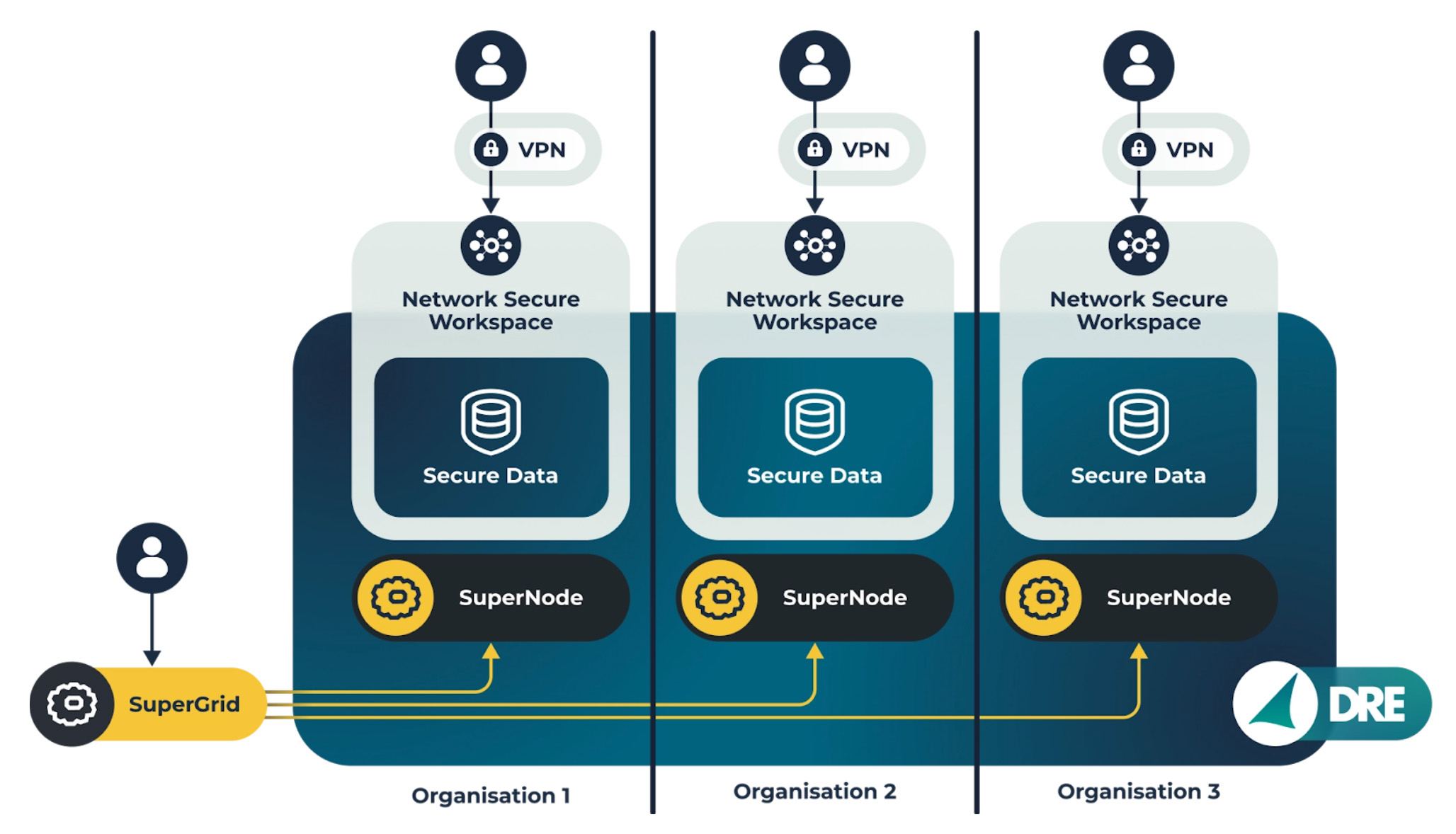
The overall architecture separates long-running infrastructure from your research code:
- Flower SuperNode runs as a long-lived process at each participating organization. It receives tasks, executes training against local data, and returns results.
- SuperLink coordinates the run and aggregation.
- SuperGrid can be used when you want a managed platform for federations that span multiple independent deployments.
In an Aridhia DRE setup, SuperNodes can run within the DRE’s secure workspaces for each organization.
Opportunities in healthcare research
For many multi-site healthcare studies, the limiting factor is not model design. It is whether teams can credibly execute across hospitals within governance constraints and within a grant timeline.
With Aridhia DRE + Flower, you can propose a practical path where:
- Partner sites run Flower SuperNodes inside the Aridhia DRE.
- Your team brings Flower workloads and models.
- The study can start earlier because the secure environment, access workflows, and deployment approach are already established.
If your funding program expects a clear plan for secure analytics, positioning Flower SuperNodes running within a trusted environment can make the path to execution feel concrete.
Opportunities for pharma research and development
Pharma teams often have a different goal than academic research groups.
They may want to:
- Fine-tune models on data they cannot centralize.
- Validate findings across clinical partners.
- Generate evidence to support decisions across the product lifecycle.
This collaboration makes it easier to explore those opportunities with real-world sites, while keeping sensitive data inside the approved environment.
Practically, it can shorten the time from “we have a hypothesis” to “we can run a multi-site federated analysis,” because the operational pattern for running SuperNodes in a regulated setting is already proven within the DRE.
Get Started
If you already develop with Flower, the next step is to align on:
- Which sites will participate and what data stays where.
- Who runs orchestration.
- What success criteria you will use for the first federated run.
To begin building:
Deployment Timeline
The combination of Aridhia’s pre-built infrastructure and Flower’s standardised components compresses deployment from months to days:
Traditional Approach

Total: ~8 months to first federated run
Aridhia DRE + Flower

Security certification: Pre-certified (ISO 27001/27701)
Total: ~1 week to first federated run
Looking ahead
We are excited to see what the research community builds through this collaboration.
If you are planning a federated study and want to explore how to run it with Flower in an Aridhia DRE environment, connect with Aridhia to discuss deployment options and potential participating sites.